
Read Greene County Deed Records
Every instrument in a Greene County deed file tells you four things. It shows who signed, what land moved, when it was recorded, and what kind of transfer it was. The index row only hints at this. The deed image is the real record. It shows the grantor's signature and the exact interest conveyed. Mortgages, liens, easements, releases, and plats often sit beside deeds in the same index. They play different legal roles, so read the instrument itself before deciding what it means.
| Deed Type | What It Does | Common Use |
|---|---|---|
| Warranty deed | Conveys title with stated covenants | Ordinary arm's-length transfers |
| Quitclaim deed | Conveys whatever interest the signer holds | Family transfers or title cleanup |
| Fiduciary deed | Conveys through an executor or administrator | Estate administration |
| Sheriff's deed | Records a court-sale transfer | Foreclosure proceedings |
| Tax deed | Records a transfer after the statutory tax process | Delinquent-tax property |
A deed transfers an interest in land. A mortgage or lien burdens it instead. A release can clear a recorded claim, but only the cross-references tell you which one. Read the whole instrument before trusting its label.
Greene Recorder Coverage Since 1993
The Greene County Recorder publishes online data and documents from January 1, 1993 forward, with some earlier material reaching back to 1980. Newly recorded documents normally post within 24 hours. That is a posting schedule, not a guarantee that the assessor's owner field changed on the same day. Deed records and the tax roll update on their own timelines.
The Recorder's mailing address is PO Box 309, Bloomfield, Indiana 47424, and the counter sits at 1 East Main Street. Hours are Monday through Friday, 8:00 a.m. to 4:00 p.m. Call 812-384-2020 before counting on terminal access or copy arrangements.
Compare Laredo and Tapestry Access
Remote deed searching offers two routes. Laredo runs on a subscription with monthly minute packages, from 250 minutes up to unlimited use, and the county says its search parameters mirror the office terminals. Tapestry EON skips the subscription. County request material lists $6.95 per search plus $1 per printed page.
Counter service still suits a simple, well-defined request. Office terminals exist but can be limited. Physical and digital copies are both listed at $1 per page. Confirm the current charge and any certification need before you order.
The official Tapestry entry screen is shown below.
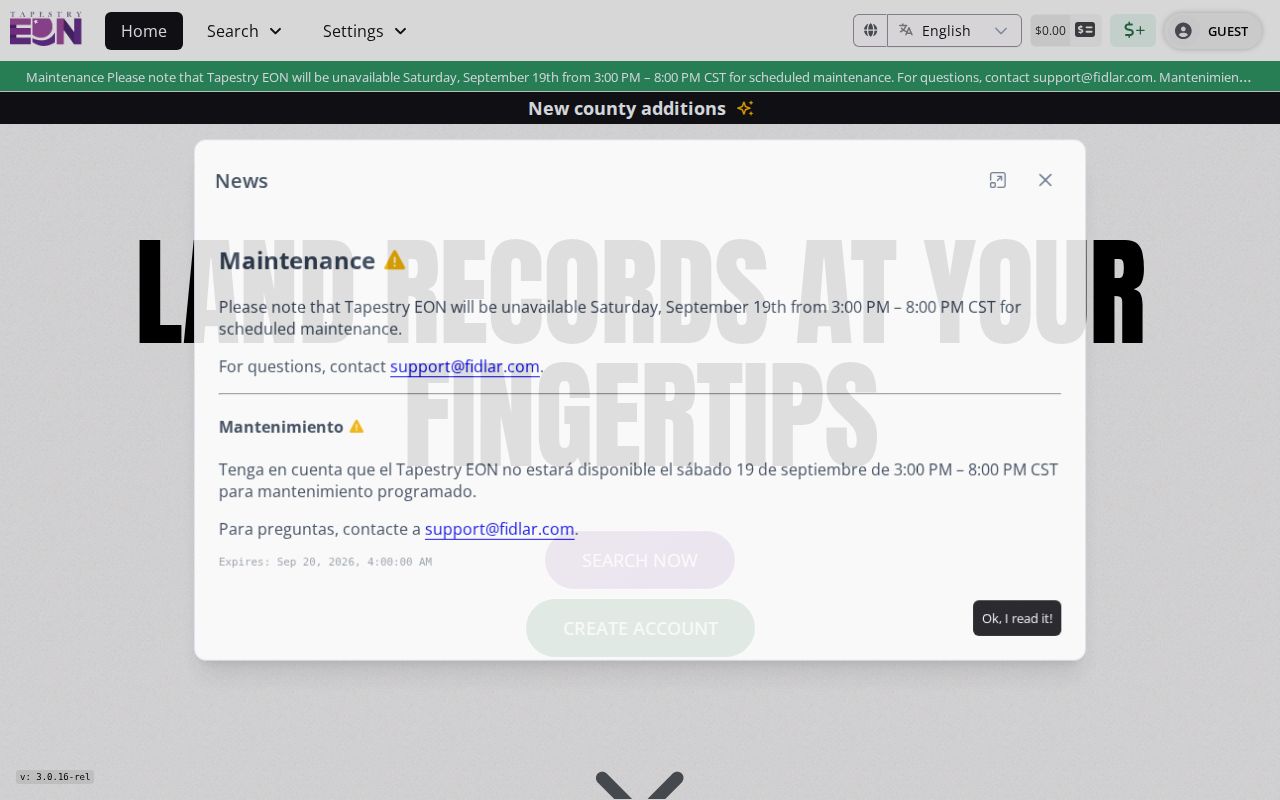
The official Recorder pages above are the remote starting point, while the office itself remains the custodian for certified copies and questions.
Trace Greene Grantors and Grantees
A grantor gives up an interest, and a grantee receives it. Keep that pair in mind when you trace Greene County deed records backward. Start with the current owner of record's acquisition deed. Hold the legal description in view throughout. The grantor named there becomes your next search as a grantee. That link sits one step earlier in the chain.
- Find the latest acquisition deed with the present owner indexed as grantee.
- Read the grantor, recording date, document number, and legal description from the image.
- Search that grantor as a grantee in an earlier date range, then match the same land.
- Repeat until the chain reaches the online cutoff, then move to deed books and microfilm.
- Grantor
- The party conveying the interest.
- Grantee
- The party receiving the interest.
- Chain of title
- The ordered sequence of conveyances tied to the same land.
- Book/page
- A volume-and-page reference used for an older or recorded document.
- Instrument number
- A unique recording identifier for a filed document.
Search Greene Deed Index Fields
Search parameters in the online index can change, so treat these as a plan rather than a fixed menu. Begin with a grantor or grantee name. Narrow the results by date. A document number or book-and-page reference from the WTH transfer data is often the cleanest path to an image.
| Search concept | Best use | Caution |
|---|---|---|
| Grantor | Find outgoing deeds | Try initials and name variants |
| Grantee | Find acquisition deeds | Match legal description |
| Document number | Bridge from WTH transfer history | Confirm the full image |
| Book/page | Locate historical references | May require counter or microfilm |
| Date range | Reduce same-name noise | Recording date may differ from signing |
Follow Greene Cross-References
Assignments and releases should cite the original mortgage or document they act on. Follow that reference every time. A release without its source document can attach to the wrong borrower or tract, and the same caution applies when a WTH transfer row shows only a short document ID.
Index sale prices also deserve image review. Greene's sample parcel card shows zero-dollar entries and a January 1, 1900 placeholder. A zero can mean an omitted value, a non-sale conveyance, or a data-conversion convention. It never proves a free transfer.
Reach Greene Deeds From 1822
The Indiana State Library microfilm finding aid lists Greene County deed books beginning in 1822. It also lists separate grantor and grantee index runs through 1902. Those volumes push a chain of title well past the online Recorder layer.
Before requesting an older reel, write down the last known grantor, grantee, date range, book and page, and the exact land wording. Lot and block references work well for platted land. Rural tracts may use section, township, range, acreage, or metes-and-bounds calls. The State Library holdings search and archives copy route can help identify an item. County counter staff can confirm local custody.
Note: Greene County was formed in 1821. The 1822 deed-book run thus reaches nearly to the start of county land recording.
Avoid Greene Recording Rejections
The Recorder's policy lists the usual rejection triggers. These include a missing legal description, grantee address, affirmation, notary detail, prepared-by statement, signature, cross-reference, or correct fee. Name and signature mismatches can also stop a filing. Poor image quality, the wrong county, and payment errors are other common causes.
These standards help you judge an incoming document. The Recorder cannot prepare it or give a title opinion. Releases and assignments must carry their original reference. Computer or typewritten text has to meet the cited black-ink and size requirements. Confirm current standards with the office before filing.
Confirm Greene Fraud Alert Availability
The Recorder's navigation shows an official property-fraud-alert topic, though the county publishes no working enrollment screen. Treat that as an access gap. Call 812-384-2020 before submitting personal information or payment to any alert offer, and keep checking the recorded index for unexpected instruments.
Order a Greene County Deed
The online image works fine for most routine research. A county copy takes a bit more detail. Give the Recorder the names, an approximate recording date, a document number or book and page, and the property description. Copies cost $1 per page, according to county material. Check whether the receiving court or agency requires certification before you order.
Sometimes the exact deed is hard to pin down. Indiana's Access to Public Records Act allows a request described with reasonable particularity, and Greene County accepts its request form in person, by mail, or by email. APRA obliges the agency to respond, though it need not create a new record or run a custom title search.
Recorded, not guaranteed. Greene County deed records show instruments accepted for recording. They do not insure clear title, resolve every conflict, or account for an unrecorded interest.