
Three Greene County Property Value Measures
Know which number you are holding before comparing anything. Indiana assessors target market value-in-use, a transfer price reflects one indexed transaction, and the taxable figure follows deductions applied to the gross assessment. Each measure has its own meaning.
| Value | What It Is | Where |
|---|---|---|
| Assessed value | Mass-appraisal value for the assessment year | WTH card and assessment records |
| Taxable assessment | Gross assessment after deductions | Treasurer or Auditor detail |
| Last sale price | Amount indexed for a past transfer | Transfer row, deed, and sales disclosure |
DLGF's ratio study tests assessment quality by dividing assessed value by sale price. It never turns an old sale into today's figure. Condition, transfer type, and dates all matter.
Read Greene County Land and Improvement Values
The Greene County WTH parcel card is the main public starting point for parcel-level values. Its sample history lists annual assessment rows, reason codes, as-of dates, the Indiana Cost Mod label, and a land figure. Trust the live card over any extract. Not every improvement or exemption field is exposed there.
| Field | Meaning | Pair it with |
|---|---|---|
| Assessment year | Year assigned to the value row | As-of date and reason code |
| Land | Land component | Parcel identity and legal text |
| Improvements | Building component when shown | Current card detail |
| Gross / taxable | Before and after deductions | Tax detail for the same year |
Mixing fields across years creates numbers the county never published.
Greene County Values in the DLGF Ratio Study
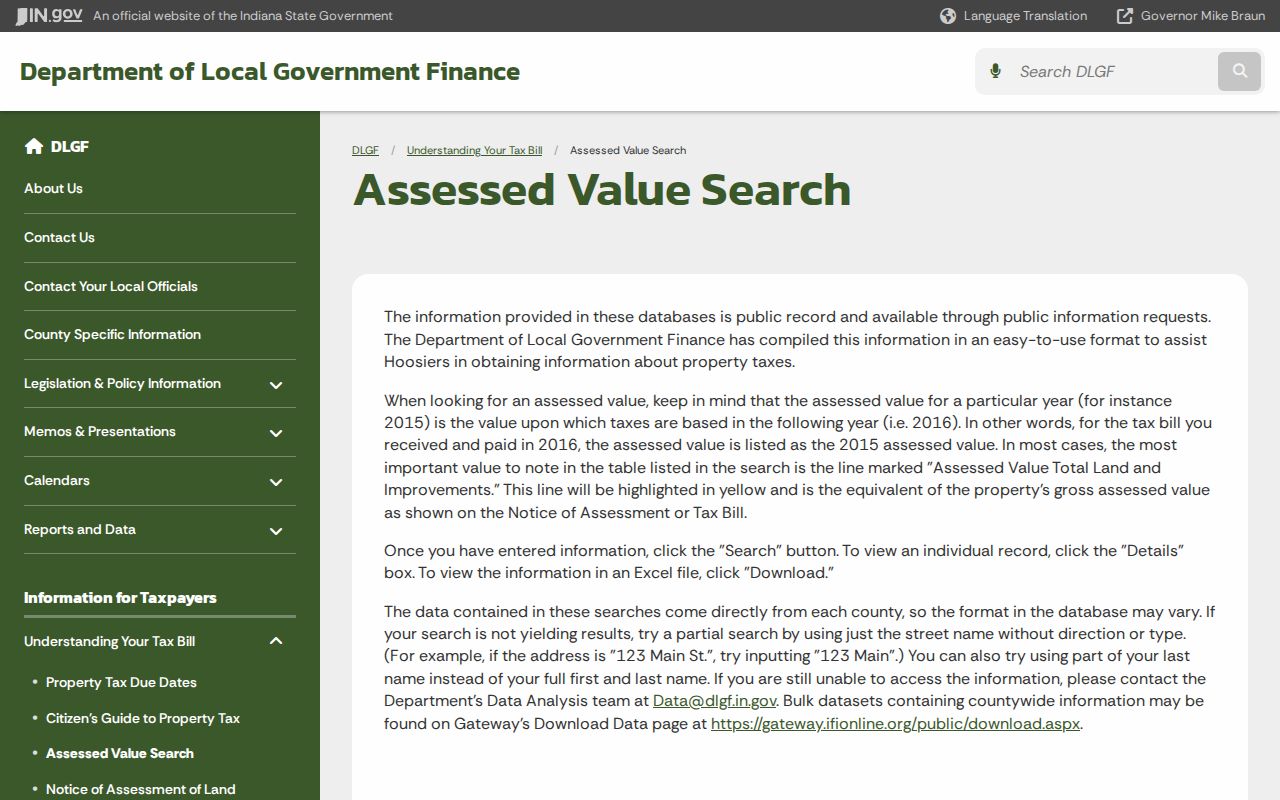
The Indiana DLGF ratio-study page defines the assessment ratio as assessed value divided by sale price. The state uses ratio statistics to test whether assessments track market value-in-use across counties. The ratio gauges assessment quality, not one home's price. The DLGF assessed-value guide explains the official route.
The county card supplies the parcel-specific values. The state page only points the way. A family transfer, fiduciary deed, tax deed, or zero-dollar row may not be an ordinary market sale, so read the instrument and the sales disclosure before relying on it.
Verify a Greene County Sale Price
A WTH transfer row can list a date. It can also list owner, document ID, code, book and page, and sale price. Sample rows include $00 entries and a 01/01/1900 placeholder. A zero may signal a conversion, omission, or non-sale. The row cannot explain itself. Use the document identifier to reach the Recorder. Tapestry, Laredo, the counter, and copy requests all work. DLGF's statewide sales-disclosure search covers disclosures after July 1, 2008. Match the legal description and parcel, not just the buyer's name.
Note: A zero or placeholder is a reason to inspect the source document. It is never proof that land transferred for free.
The 2026 Greene County Reassessment Context
Indiana's next statewide cyclical reassessment begins July 1, 2026, on a four-year physical-inspection cycle. Greene County's DLGF entry says no Form 11 notice will be mailed for that cycle. June 15, 2027 is the appeal deadline. It explains jumps between annual rows. Reassessment is not a sale. Whenever you quote a Greene County property value, preserve the assessment year, as-of date, and source.
Look Up a Greene County Assessed Value
Start with an address, but finish with the parcel number. A mailing address or a similar owner name can pull the wrong property into a comparison. The exact row keeps the value honest.
- Search the address or parcel in WTH and confirm situs, map position, and legal description.
- Copy year, as-of date, reason code, land value, and improvement or total fields shown.
- Open Treasurer or Auditor detail for gross assessment, deductions, and taxable assessment in that year.
- Review transfer rows, then verify an important amount against the deed and sales disclosure.
- Assessed value
- The mass-appraisal figure attached to an assessment year.
- Market value-in-use
- Indiana's standard for property in its current use.
- Assessment ratio
- Assessed value divided by sale price in DLGF analysis.
- Sale price
- A transaction amount read with its deed type and disclosure.
Deductions Change Greene County Taxable Value
A deduction shrinks taxable value without touching the facts. County detail may show gross assessment, deduction categories, and the resulting taxable amount. Compare like fields within one year. Never reverse-engineer a tax total into a market estimate. The Greene County property tax guide covers bills, exemptions, and appeals; valuation work stops at what each number means.
Compare Greene County Value History Carefully
Annual rows show when an official assessment changed. They rarely show why. A physical change, corrected data, reassessment, split, combine, or timing difference may sit behind the movement. Check reason codes, legal text, and parcel identifiers. If an identifier changed after a split or combine, the tax list suggests searching the owner's last name and asking the Treasurer about the parcel. Do not splice predecessor rows without documenting the link.
GIS Context Does Not Price Greene County Property
Aerials and district layers add context. WTH measurements and screen boundaries stay approximate. Visible neighbors are not verified comparable sales, so a sound comparison needs similar property facts, a relevant date, and evidence that each transfer was usable.
Comparison limit. Map proximity alone does not make another parcel comparable, and an assessment record is not a private appraisal.
Greene County Value Records Beyond WTH
A stubborn parcel card has other routes. The Treasurer and Auditor CGI lists work by district, parcel, name, tax year, and property address. The Auditor's vendor-hosted assessment portal publishes assessment statistics and valuation reports searchable by word or group. These channels are alternatives. Record source, search date, and year beside each figure.
A written APRA request can ask for an existing parcel assessment record. Give the parcel number, property address, owner string, assessment year, and exact field sought. Be reasonably particular. The county need not build a new analysis. For a value opinion beyond the public record, use a qualified appraiser rather than asking a records office to calculate one.
Limits of a Greene County Property Value
A Greene County assessor value exists for one job: running the property-tax system. It can trail an actual sale. It can miss a recent improvement. It can even clash with a price, simply because the two figures record different events. A deed transfer amount, meanwhile, is history on paper. It is not a forecast of what a buyer would pay today. For a firm number tied to a date and a purpose, neither the tax roll nor the deed records replace a formal appraisal.
Value versus price. Greene County assessed value is not what a property is certain to sell for. Use a qualified appraiser when a defensible current market opinion is needed.