
Find Who Owns Greene Property
Each step in the ownership method answers a different question. WTH identifies the parcel and reads the roll's current owner label. Tax records cross-check the deeded owner. The Recorder supplies the accepted instrument. Keep the whole workflow centered on the land rather than on a broad personal profile.
- Enter the full address in Greene County WTH ThinkGIS and select the right parcel by map point, tax district, and legal description.
- Copy the owner and mailing block, situs address, full parcel number, Tax ID, and newest transfer reference.
- Check the parcel in the Treasurer or Auditor tax list for the Deeded Owner label and effective-dated owner history.
- Locate the newest deed through the Recorder and match its grantee and legal description to the subject land.
The Greene County WTH interface used for the first step appears here:
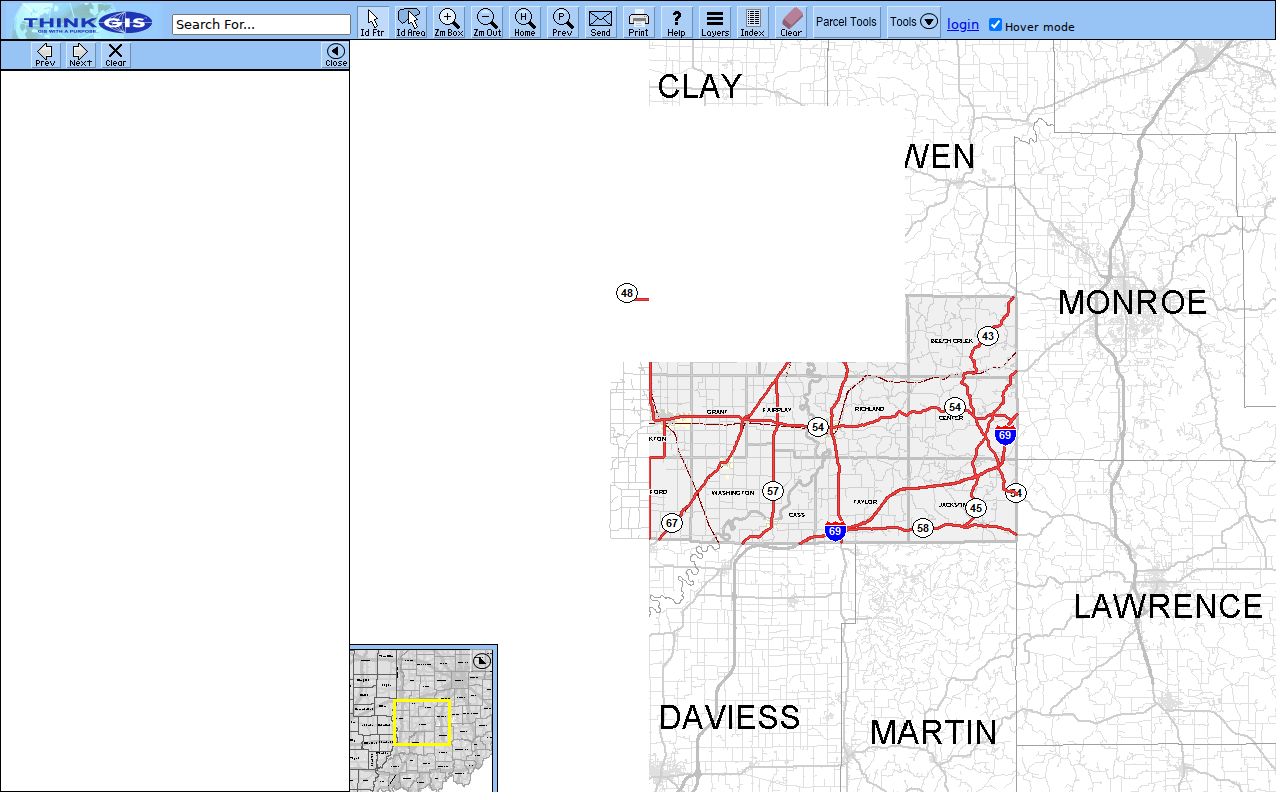
Map search finds the parcel. The Recorder supplies the confirming deed.
Compare Greene County Owner Sources
No single Greene County owner source answers every question. The assessment roll is the quick, parcel-centered place to start. A deed remains the actual recorded transfer of ownership. GIS adds the geography. A business filing can pin down an entity's exact legal name. Each source updates on its own cycle and carries its own legal weight.
| Where ownership appears | What it provides | How current |
|---|---|---|
| WTH owner block | Roll owner, mailing line, parcel and legal data | Assessment-cycle record |
| Treasurer or Auditor detail | Deeded Owner and effective-dated history | Tax-system cycle |
| Recorder deed | Grantor, grantee, instrument and land description | New documents usually online within 24 hours |
| INBiz entity filing | Business name and registered filing context | Entity record, not title |
Owner of record is not the same as occupant. A Greene County listing can show CFC, LLC with a Bloomington post-office box, yet the legal description points to Solsberry Lot 33. The mailing address simply tells you where the tax bill and official notices travel. It proves nothing about who lives at the situs.
Trace Greene Owners to Deeds
The Greene County Recorder posts online documents and data from January 1, 1993 forward. Scattered earlier material reaches back to 1980. Fresh recordings usually show up online within 24 hours. For remote deed records, Tapestry works without a subscription. Laredo requires one. Counter help, mail, email, and copies stay available when a remote search falls short.
Pull the document ID or book/page from WTH transfer history. Track down the newest deed. Verify the grantee, the legal description, and the recording date. The assessment roll can lag a recent closing. Tax and property records update on a different cycle than the recorder's index. When sources disagree, the newest accepted deed is the stronger transfer evidence. The Greene County current owner page digs into this present-record timing problem.
Note: The Recorder's 24-hour posting statement is an expectation. It does not guarantee that every index field or image is instantly complete.
Separate Greene Property Addresses
One Greene County parcel can carry four different identifiers. These are a situs address, an owner mailing address, a postal city, and a legal description. These are not interchangeable. The situs marks the property's assigned location. The mailing address is where the tax notice goes. A legal description fixes the land itself through subdivision, lot and block, section terms, acreage, or metes-and-bounds.
ZIP geography creates its own trap. Indiana PACE data places 47424 entirely inside Greene County, but 47438 and 47462 straddle county lines. A mailing-city or ZIP match cannot settle county or municipal jurisdiction on its own. Check WTH geometry, county prefix 28, the tax district, and the legal description. Only then tie an owner name to any parcel.
- Owner of record
- The owner name carried on the maintained assessment or tax roll.
- Grantee
- The party receiving the interest in a recorded deed.
- Situs address
- The location assigned to the property itself.
- Mailing address
- The destination for owner notices and correspondence.
- Title
- The legal ownership interest evaluated from the full record, not one index field.
Identify Greene Entity Ownership
Owner searches in Greene County often turn up LLCs, trusts, estates, and ET AL labels instead of a person. Copy the name exactly. Even punctuation or a suffix can shift your results. Indiana INBiz verifies a business filing and its registered name, though the agent or managers listed there are not automatically the property owners. Only the deed shows which entity actually received the parcel.
A fiduciary or estate label may hint at probate. Indiana MyCase can locate public case entries. The Greene County Clerk handles local court records and older material. A probate caption explains why authority changed before a fiduciary deed recorded, but it never replaces the deed that identifies the parcel and its owner of record.
Use Greene Owner Search Fallbacks
Greene County's online owner routes are uneven. WTH serves as the main map and assessment starting point. The Treasurer and Auditor CGI pages expose owner name, parcel number, tax year, and property address. Charges, payments, and balances appear there too. Those pages can be unstable, though. The tax search favors a last name, and too much input can restrict results. Recent parcel splits or combinations may force a last-name search plus office help.
Recorder Tapestry runs $6.95 per search and $1 per printed page. Laredo sells subscription minute packages, with county copies listed at $1 per page. When an owner record stays hidden, Greene County APRA guidelines permit a focused request. It can go in person, by mail, or by email. Ask for a defined parcel record or deed. Indiana APRA does not require an office to create a custom analysis.
The Greene County Recorder keeps hours Monday through Friday, 8:00 a.m. to 4:00 p.m. Its contact record lists PO Box 309, Bloomfield, Indiana 47424, phone 812-384-2020, and recorder@co.greene.in.us. Include the parcel number, legal description, party name, and approximate transfer date. Add any document ID already found. A focused request lets staff locate the existing record quickly. It also spares the office a broad search of unrelated names.
If a tax page will not load, keep the WTH parcel key. Try the Auditor route alongside the Treasurer route. Ask which tax year and effective date the owner label represents. That answer explains freshness, but it does not replace the deed. This fallback chain keeps the question "who owns this property?" tied to official county channels. It holds up when one portal fails.
Verify Greene Fraud Alert Claims
The Recorder's navigation includes an official property-fraud-alert topic. Yet no working Greene County signup screen sits behind it. That gap is real. Confirm any alert service directly with the Recorder at 812-384-2020 before entering parcel or identity details into an unverified form.
An alert, if available, would flag recording activity. It would not block a filing or certify title. The sound response to an unfamiliar instrument is to obtain the recorded image, compare its parties and legal description, and contact the Recorder. A current owner search can reveal a mismatch, but it cannot replace that document check.
Apply Greene Owner Findings Carefully
Owner records support purchase diligence and easement questions. They also help with boundary contact, estate research, tax matters, and possible deed fraud. They do not reveal who occupies a building. Nor do they show whether an owner may lawfully sell. Hidden title defects may also wait underneath. Commercial tools also mix stale addresses with old names. Official parcel and deed records are the better route.
The public mailing line offers a lawful contact route for a property-specific note. Indiana's Address Confidentiality Program may swap a substitute address for a protected person's actual one. Never try to defeat that safeguard. Keep research tied to the parcel question. Verify any decision with the custodian or an appropriate title professional.
Set Greene Owner Search Limits
Records answer the ownership question only so far. The tax roll names the current owner of record. The latest deed records a conveyance. Neither proves occupancy, resolves every lien or easement, guarantees marketable title, or fixes a boundary. Trusts and business structures can also make the grantee an entity rather than a natural person.
A title search reviews the relevant chain and encumbrances with legal purpose and expertise. A licensed survey handles disputed ground lines. Keep those tasks distinct from a quick owner lookup. When a deed predates online coverage, Recorder books and State Library microfilm extend the trail rather than a commercial person search.
Lawful use. Greene County owner records support legitimate property research. Never use owner names, mailing lines, or parcel details to harass, threaten, or harm anyone.