
Start a Greene County Property Search
Greene County property records live across the Recorder, Auditor, Assessor, and Treasurer. WTH GIS, courts, and archives hold more. Start with WTH ThinkGIS when an address is known. The map ties that point to a parcel number. It also shows the owner and mailing block, legal description, transfer rows, and assessment history. Carry the parcel number to the tax list. Carry the owner or document ID to the Recorder index. Official entries are evidence. But no portal alone is a title search, appraisal, or legal survey. The WTH ThinkGIS page displays Greene County's search environment.
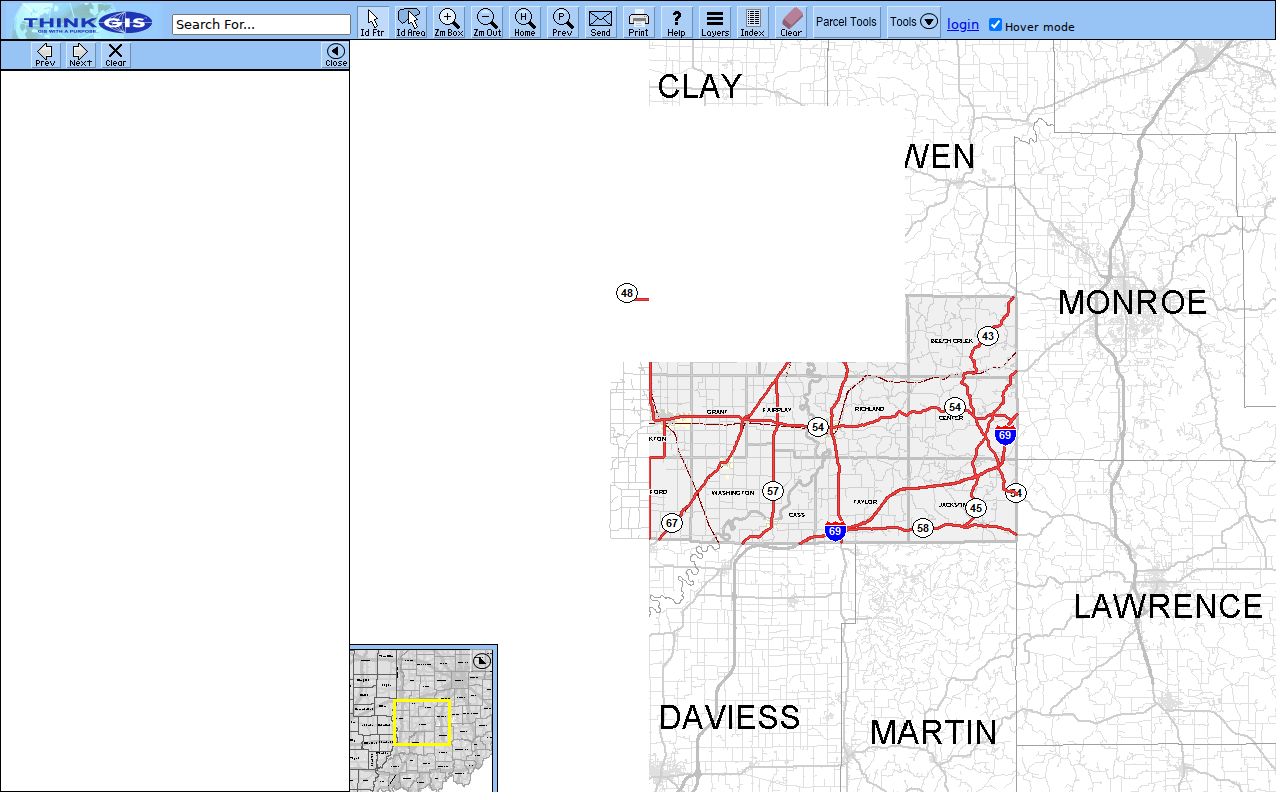
Use the parcel facts as cross-references. Then verify each deed entry and tax entry with the office that holds the official record.
- Search WTH by address, owner, parcel, intersection, or other text.
- Save the parcel number, situs, mailing address, legal description, and transfer references.
- Check Treasurer or Auditor records for the chosen tax year.
- Confirm each conveyance in the Recorder's deed image.
- Use counter service, APRA, or microfilm when online access ends.
Greene County Property Records Custodians
Each Greene County office answers a different question. The Recorder keeps conveyances and recorded encumbrances. Assessor and Auditor sources show the roll, deductions, and parcel values, while the Treasurer handles charges, payments, and balances from the courthouse in Bloomfield, the county seat.
Greene County Assessment Data
County courthouse offices
Bloomfield, IN 47424
812-384-2003
Greene County Treasurer
County courthouse offices
Bloomfield, IN 47424
Verify with county
Greene Recorder Records Online
Online Recorder data covers January 1, 1993 forward, with selected material reaching back to 1980. New documents usually post within 24 hours. Tapestry EON offers non-subscription remote access, while Laredo runs on monthly subscription minutes. County material lists Tapestry at $6.95 per search. Printing and counter copies each run $1 per page. Save the legal description and recording reference, because party-name spelling alone can build a false chain of title.
Greene Deed Books Reach 1822
The online layer is just the newest tier. The State Library microfilm finding aid lists Greene County deed books beginning in 1822, with grantor and grantee indexes through 1902. A title trail can therefore run backward from a modern parcel card into those early volumes. At each step the prior grantor becomes the next grantee searched. Match the lot, block, or metes-and-bounds description. Only then step back another deed.
Greene County Property Record Types
Match the record type to the question. A deed answers conveyance. A tax page covers assessment and payment, a plat records a subdivision plan, GIS locates the mapped tax parcel, and court files may explain a disputed or forced transfer.
| Record Type | What It Documents | Kept By | Access |
|---|---|---|---|
| Deeds | Recorded conveyances | Recorder | Laredo, Tapestry, counter |
| Mortgages and liens | Recorded claims and releases | Recorder | Index, image, copy request |
| Assessment and tax | Values, deductions, charges, payments | Auditor, Assessor, Treasurer | WTH and county CGI |
| Plats and parcels | Lot descriptions and map context | Recorder and GIS | Recorded plat and WTH viewer |
| Property cases | Foreclosure, partition, quiet title, probate | Clerk and courts | MyCase and Clerk request |
Use Greene County deed records for the instrument trail. Turn to property tax records for bills, deductions, and appeal data; WTH stays a cross-reference, not the final word.
Greene Values Need Three Labels
Assessed value supports tax administration. Taxable assessment reflects deductions. Sale price records a transaction and may surface in WTH transfer history or a sales disclosure. Indiana's ratio study compares assessed value with valid sales to test market value-in-use. None of these figures is a current appraisal. The 2026 statewide cyclical reassessment begins July 1, 2026 for 2026 Pay 2027, inspecting about one quarter of parcels each year. Values can shift without any ownership change.
Greene ZIP Codes Can Mislead
ZIP 47438 crosses the Greene County line, and 47462 crosses it too. A mailing city proves nothing about county or municipal jurisdiction. Check the county prefix, tax district, parcel geometry, and legal description before drawing conclusions.
The same distinction matters for permits. Greene County does not currently issue building permits. A city land-use record or a Health Department septic file may still exist, so identify the municipal authority and request records for the exact address and date.
Map Greene County Parcels Carefully
WTH blends parcels with roads and aerial imagery. Configured district layers can be searched by address, intersection, owner, parcel number, or other text. Identify opens the selected feature. Identify Areas lists named boundaries around a clicked point, which can reveal context even when a layer stays hidden. Those tools help preserve the map view. Print, email, measurement, area, and coordinate options keep a record of what appeared.
None of that creates a survey. A tax polygon may be generalized, and a road centerline may hide a legal right-of-way. For a boundary question, compare the mapped parcel with the recorded plat or deed description, then obtain a licensed survey when stakes or improvements depend on the line.
Greene parcels can appear under three number styles. A full identifier carries county prefix 28. A tax ID may drop that prefix and shorten the district suffix. Older records can still show a map number. Save every version with the legal description, since splits and combinations can change a current parcel key.
Note: WTH documents Identify Areas but offers no buffer, select-by-location, or adjacent-parcel command.
Check Greene Property Court Cases
Deed records rarely tell the whole story of a disputed transfer. Foreclosure, partition, quiet title, probate, tax-deed, and lien cases live in the courts instead. Indiana MyCase covers these matters for Greene County. A known case number makes the search simple. Party search also works with a business or personal name. The official tips explain wildcard and sounds-like options.
A result can list the case number, type, parties, court, and status. It can also show the disposition and any non-confidential documents. Depth varies for older files. The Greene County Clerk holds the missing and historical ones. Tie a case to land through a legal description, deed reference, or similar record fact. A matching party name alone proves nothing about the parcel.
Federal property matters serving Greene County go through the Southern District of Indiana's Terre Haute Division. PACER is the access point for those files. Use that route only when federal jurisdiction is already part of the trail.
Request Greene Records Under APRA
Indiana's Access to Public Records Act, IC 5-14-3 et seq., gives the public the right to inspect and copy records during regular business hours. You usually need not say why you want them. The request itself must describe the records with reasonable particularity. Greene County provides an agency form, and returns can come in person, by mail, or by email.
A written request does not force instant production. The statewide handbook sets a seven-day acknowledgment rule. The actual records may follow within a reasonable time. An agency has no duty to create a record, run custom analysis, or answer a broad question. Name the deed, parcel list, tax-sale notice, plat, inspection file, or case document, with dates and identifiers.
Greene's guidelines also set copy fees. Recorder and Clerk copies cost $1 per page. Clerk certification is $3. Other county offices charge ten cents per black-and-white page, twenty-five cents for color, and $5 for CD or DVD media. Confirm the current amount with the custodian before paying. A denial should state its legal basis, and you can request any segregable public portions.
Protect Addresses in Greene Records
Public access has limits. Indiana's Address Confidentiality Program is known as Safe at Home. It gives eligible survivors of domestic violence, sexual assault, stalking, human trafficking, harassment, intimidation, and invasion of privacy a substitute address with mail forwarding. It is not witness protection. It cannot promise a true address will never surface anywhere.
Official property records also stay separate from data held by private companies. Indiana's Consumer Data Protection Act began enforcement January 1, 2026. It gives qualifying residents rights against covered private controllers. These include access, correction, deletion, and opt-out requests. The law's public-record exclusion still applies. Such a request cannot erase a lawful Greene County deed, tax entry, or parcel card.
Scam awareness belongs beside access. A caller or letter may borrow public owner names, parcel facts, or recording language. It can sound official. Verify any fee, deed-alert offer, tax demand, or urgent transfer claim with the real custodian. The Recorder navigation includes a property-fraud-alert topic, though the county publishes no functioning signup screen. Confirm availability directly at 812-384-2020.
Use Greene Archives for Context
Historical property research draws on more than deeds. The State Library's Greene County guide points to WPA marriage, birth, and death indexes, wills, probate material, naturalizations, court records, newspapers, libraries, and the Greene County Historical Society. Each can surface an estate, old business, subdivision name, or court event that supplies the next land-record search term.
Bloomfield became the county seat in 1824 after the earlier Burlington site proved nearly waterless. That story doubles as a navigation clue. Even when a parcel sits near Linton or Jasonville, the county Recorder, Clerk, Auditor, and historic courthouse trail lead back to Bloomfield. The Historical Society and county-seat repositories offer fixed places to chase older references.
Treat contextual sources as leads. A newspaper mention or directory occupant does not prove ownership. Test the name against the assessment roll and deed chain. The parcel description remains the controlling link.
The State Archives search works best with names, dates, and catalog identifiers. These include Page ID, Local ID, and Level ID. Staff can clarify where an item sits. It may be in Indianapolis or remain with a Greene County office. Record copies should keep their source and access date. An archive citation is part of the evidence trail.
Keep a short research log of search terms, portal dates, failed routes, and copy references. That habit prevents repeated dead ends. It also lets another reader reproduce the Greene County record trail.
Limits of Greene County Property Records
Greene County property records carry real weight. A parcel file can show the assessment owner, the mailing address, a recorded deed, a lien, a value, a tax status, and the parcel polygon on the county's GIS map. The legal description often hides a useful clue too. Still, records have limits. No file can guarantee clear title, prove who occupies a building, fix a surveyed boundary, or stand in for a current sale appraisal.
Indiana's APRA backs your right to inspect and copy public records when you describe them with reasonable particularity. The office itself decides what stays protected, and it need not build a new record or run a custom analysis. Indiana's Address Confidentiality Program can also swap in a substitute address for eligible participants.
Lawful use. Greene County records support purchase diligence, boundary research, appeals, estate work, and civic review. Never use owner information to stalk, harass, or harm anyone.